Friday, February 1, 2013

Red fruit-veggie smoothie?


So, we had this leftover salad with beets, pine nuts, and arugula...


...and I thought, "why not put it in this cup,"


"and add some of this sweet apple pear cactus juice"


"and blend it all into a red fruit veggie smoothie?"


The idea was to recreate something like Naked juice, which I really like.


Here goes...


What is that taste? 


Can't quite place it...


Uch, raw shallots.  Forgot those were in the salad, too.


Sorry, red buddy, there's no hope for you.  You're getting dumped in the trash.

Meringues


Every now and then we tinker with ice cream recipes, which generally call for egg yolks.  But what do you do with the whites?  Obviously you whip them up and make meringues, because the other options - chocolate mousse and sponge cake - require the yolks and you only have the whites.

All you really need to add is sugar (a cup, give or take whatever you feel like), though cream of tarter helps stabilize the foam and vanilla adds flavor.  Plastic is the perfect pastry bag material for meringue, because the former is hydrophobic while the latter hydrophilic... anyway, just snip off a corner of a ziplock bag and let your creativity do the rest.

Meringue can be baked in two ways: low and slow or hot and fast.  Low and slow gives you a nice crunchy meringue, maybe just a little chewy in the center, if you like that.  Hot and fast gives you a toasty outside, and fluffly, still-kind-of-raw insides.  We kind of did something halfway between the two, ending up with sticky, chewy meringues.  Still delicious.

Wednesday, January 30, 2013

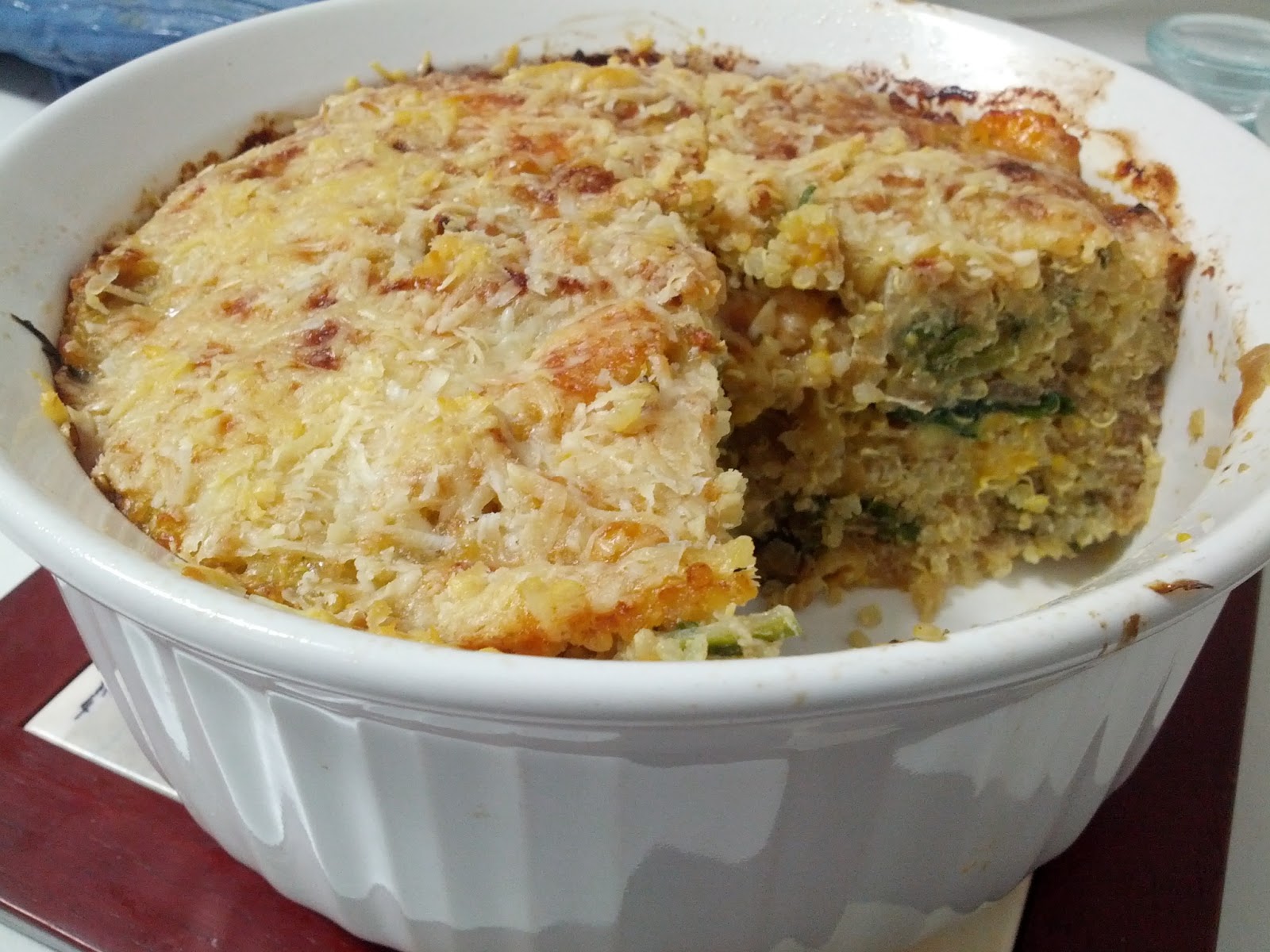
Cheesy quinoa pashtida


Would you believe me if I said quinoa is our new favorite food?

I remember tasting quinoa a long time ago and not liking it.  That's what happens when you treat it like rice and serve it barely seasoned, as a side dish.  Boring, bland, and weird texture.

But then we started tasting quinoa with other savory ingredients mixed in, and seasoned.  We tried some vegetables with quinoa stuffing.  The trick to quinoa is to mix it together with lots of other delicious things, and that led us to adapt this dish from a recipe we saw somewhere.

We've made this about four times in the last six weeks, and each time it's a little different.  The quinoa always gets soaked in water, then strained, and then boiled in 2 times whatever volume of dry quinoa you started with.  We always add chicken soup mix to the boiling water, which does a great job covering up quinoa's natural bland taste.

Then, sautee vegetables of your choice - we used onions, garlic, zucchini and מנגולד - a type of chard - with salt, pepper, garlic, etc.  After the quinoa is cooked, mix it with the veggies, 1 egg per cup of dry quinoa, and cheese.  Pour into a baking dish, top with grated Parmesan cheese and bake till bubbly.

With all that soup mix, egg, and cheese, one might wonder if the quinoa is really contributing here.  Believe me, it is.  Maybe not so much taste wise, but it definitely gives the whole thing a unique and addictive texture.    It's easy to eat through an insane amount of this stuff without even realizing.  Pretty much every time we make it for dinner, we have to force ourselves to save enough for lunch the next day.

Try it.

Tuesday, December 25, 2012

Go-to pizza toppings

These are some pizzas I made over Sukot, using the same dough I always use.  The pizzas tasted great, as all pizza does, but I'm far from satisfied with my crust.  I have long since ceased baking pizzas directly on my small round stone; the only way to avoid the invariable burning mess (when part of the pizza dangles over the stone) is to make unacceptably tiny pizzas.  Instead, I form the crust on a thin aluminum sheet, and bake that on the stone.  It's a method that seems to be getting worse with time, and I've reached the point where the crusts barely browns at all underneath.  The culprit may be oven temperature, or aluminum's heat capacity, or even soft Israeli flour.  I'm sure a good baking steel would solve my problems, but I don't know where to get one here and probably couldn't afford it anyway...

But I digress.  Here are some tasty pizzas:


Mozzarella, tomato sauce and basil.  Classic.  I went with the little balls of מוצרלה בייבי, a slight upgrade from theגבינת עמק on all the rest of the pizzas.  You can taste the difference, but only just.  The basil was fresh from the gahhden.


Carmelized onions, גבינת עמק, thyme, a dash of balsamic vinegar.  No tomato sauce.


טבעול veggie burgers sliced thin, fried in olive oil until crispy and seasoned with hot paprika.  גבינת עמק, tomato sauce.  Use Morningstar burgers in the US.


Mushroom pie.  Can't beat it.

Root Vegetable Soup


Around here we play a little game with the produce in the fridge.  It's called What's Gonna Go Bad Next?  The object of the game is to spot vegetables that look the most vulnerable to extended fridge time, and then make dinner out of them.  What are we going to do with that half bag of spinach?  We should REALLY use those zucchinis soon.  Ooooh, the cucumbers went bad.  Again.  (What is it with cucumbers?)

Sometimes, though, the game gets tiring.  For those times, it's good to make dinners like this one.  See, all the ingredients in this soup - onions, carrots, potatoes, and squash - are all things that we can count on having around and not going belly-up all of a sudden (although the carrots eventually get rubbery, which is the weirdest thing ever).

Besides the vegetables listed above, the soup was seasoned with chicken soup mix, pepper, garlic, and some paprika.  We like chicken soup mix, but you could probably get away without it if you don't want to use it, especially if you throw in a more aromatic root like parsnip.

Oh, and this soup is really good with pita chips like the one pictured above.  Just split some pita, cut into wedges, spray with some oil and season with salt and pepper before broiling in the oven.  Don't let them burn.

Friday, December 21, 2012

Kimchi

From everything I'd ever read about kimchi, it sounded like the best thing I've never tried - pickled cabbage seasoned with salt, sugar, soy sauce, fish sauce, ginger, chili pepper, and unholy amounts of garlic.  Actually, when I put it like that it sounds like heartburn, but still delicious.

Alas, our local שופרסל does not sell kimchi.  But I kind of wanted to make it myself anyway.  To do so, I used a recipe from Modernist Cuisine.  (It's kind of pathetic, but after having owned the book for over a year and a half, this might be the first actual recipe I've tried from it.  It's still an amazing book, but I use it more for reading and inspiration).  The recipe:

Sugar 75g
Salt 22g
Napa cabbage 825g
Garlic 100g
Fish sauce 65g
Light soy sauce 62g
Chili powder 48g
Scallions 37g
Ginger 25g
Carrot 30g
Dried salted shrimp 7g

Like all recipes, though, I had to make some changes.  It called for napa cabbage, which I couldn't get.  שופרסל online was selling something called כרוב סיני, so I ordered that.  When it arrived, I realized it was bok choy.  After a little Googling, I decided that bok choy wouldn't make good kimchi, and opted to go with plain cabbage instead.

Dried shrimp had to go, of course, but I did have the fish sauce!  This is quite an achievement, as it's very hard to find kosher fish sauce.  מזרח-מערב on Agripas in Jerusalem has it, as may other branches of this store.  The stuff kind of reeks, and Rachel once ran out of the room gagging when I tried cooking with it.  This might explain why not many have bothered making it in kosher form...

The first step was to combine the salt with 30g of the sugar, and rub down the cabbage.  I messed up and mixed the salt with ALL the sugar and rubbed down the cabbage:


Then, you let the cabbage sit in the fridge for 12 hours, after which you drain it, and mix it up with the rest of the ingredients (including the rest of the sugar).  I sort of compensated by throwing in a random amount of sugar.

Then you prep all the other stuff.  Side note - 100g of garlic is A LOT OF GARLIC.  Several heads.  Lots of garlic pressing.

Here's what it looked like to rub this mess onto the cabbage:


And here's all the cabbage, rubbed up and packed into a jar:


Then, all that's left to do is let it ferment for 24 weeks.

Wait.

Did I read that correctly?  24 weeks?  Are they insane?

Ha ha!  Turns out, there's a typo in my Modernist Cuisine cookbooks and it says 24 weeks instead of 2-4 weeks.  Good one, MC!

After about 3 weeks, we started eating it by itself:


Or sometimes with noodles:


My conclusion: kimchi is good stuff.  The cabbage stays crunchy, like sauerkraut.  Also like sauerkraut, it has an acidic touch to it.  And, it goes without saying, the stuff is knock-your-socks-off spicy and pungent.  A real punch in the mouth.

Therein, however, lies a dilemma.  The kimchi has such a strong taste that we don't really eat it alone.  We've been told that kimchi goes best with meat, but a) it has fish sauce in it (and I assume that's a problem) and b) I stupidly cut all the vegetables with a dairy knife.  So we can't have it with meat, and we still have a bunch of it sitting in the fridge.

Anyway, I'm sure this is just the first stop on a lifelong voyage through the land of DIY kimchi.  But before making the next batch, I think I'll detour for a batch of sauerkraut...


Friday, November 2, 2012

Shepherd's Pie


Sometimes I wonder if I'm the only person in the world who likes plane food.  Maybe the better question is: why do I like it?  Could the explanation be psychological?  I never flew on a plane at all until I was 13, and when I did, it was very exciting.  I actually still feel a small thrill of excitement every time, even though it's quickly outweighed by discomfort, impatience and occasional fury.  Perhaps my taste for plane food is related?  Or maybe there is a simpler explanation, such as the fact that plane food is heavily salted and spiced to compensate for a muted sense of smell and, consequently, taste (caused by intentionally dry airplane air - or so I read in the NY Times).

Either way, I always find my plane meal satisfactory, and occasionally even inspiring.  Such was the case after eating a shepherd's pie on a flight out of London; I simply had to make it, and sukot was the perfect opportunity.

Scholars debate whether shepherd's pie must have a bottom crust, but I chose to go without.  I made the filling in a large skillet.  First, two onions and two carrots got chopped and sauteed  with salt, pepper, garlic and paprika.  After a few minutes, in went a kilo of ground beef.  Once this was browned, in went a chopped package of white mushrooms, about a cup of red wine, and a healthy squirt of ketchup.  The whole thing was mixed together, and seasoned with fresh rosemary (though dried would work too), cooked down a bit, and scooped into a Pyrex.

The top contains 4 or 5 potatoes that were peeled, chopped, and boiled until soft, and then mashed with about half a stick of margarine and half a cup of soy milk, and seasoned with salt and pepper.  If I could do it again, I'd leave out the soy milk.  The idea was to make the potatoes creamy, but it also gave them a sweet soy milk taste.  I find Israeli potatoes are slightly sweet anyway, and the soy milk didn't help.  Once the topping is mashed and seasoned, it gets spread over the filling and put under the broiler.  Everything is already cooked; the point of the broiler is just to give some nice brown spots on top.

Oh, I also threw some cabbage into the filling, simply because I had some leftover from stuffed cabbage and couldn't think of anything else to do with it.  That's why I didn't mention it before.  You can do this with lots of things - spinach, broccoli, squash, celery, zucchini or pretty much any veggie would work.  When in doubt, toss it into the shepherd's pie.