Sunday, December 7, 2014

Chicken gumbo

Rachel fell in love with chicken gumbo when she was an impressionable undergrad at Stern. The gumbo came from Mendy's and it was unparalleled, or so she remembers.

Unparalleled, you say? Sounds like a challenge. Let's make gumbo.


Gumbo starts with a red roux. Equal volumes of vegetable oil and white flour (1/3 cup each I believe) are cooked over medium heat.


After 10 or 15 minutes, it will develop into a deep reddish brown:


Next, dice onions, celery and green pepper (the Creole variation on the classic French mirepoix), and toss them into your ruddy roux. Add half a bag of frozen okra, and a 1 kg of chicken wings. Season with salt, pepper, paprika, garlic, and thyme. If you use fresh thyme, tie up a bunch of sprigs with a few other sprigs twisted into a rope, like so:


Cover everything with water and bring to a boil:


We ate this for Shabbat, so once a boil was reached, the gumbo was transferred to a crock pot set on low:


Finally, chop up some beef chorizo sausage and throw it in. Beef chorizo is not the traditional gumbo sausage. That would be andouille sausage which, alas, is not available in Israel. And contains pork. Chorizo it is, then.

Cook on low for several hours. If you put up the gumbo by late morning, and have it on low until dinner, it will be perfect, I promise. Between the starch from the roux and the unctuous polysaccharides exuded from the okra, the gumbo will be thick, wonderfully flavorful, and deeply satisfying.

[One final note - the gumbo will still be tasty for Shabbat lunch, but not as good as Friday night. Some components break down and it isn't quite as thick.]

Wednesday, March 5, 2014

Taco night


We've talked about tacos before, but can you believe it's been over two years since Rachel and I made these? That's because these tacos are made with meat #14 (I think it's called פלדה), which is a hind cut, and hard to find.

I was always under the impression that, in Israel, hind cuts are generally available in most places you go to get meat. This impression was based on the knowledge that Israeli shochtim perform ניקור, the process of removing the גיד הנשה. This is true, but it turns out that the reality is this: hind cuts exist in Israel, but most butcher counters don't have them, and frozen meat sections definitely don't have them.

The reason seems to be that the majority of meat is imported from חוץ לארץ, especially South America. There, the hind quarters are simply sold off to non-Jews, so they don't make it here. I'm pretty sure nearly, if not all frozen meat is imported, and a lot of the fresh meat you see at the counter probably is too.

This week I was told that the only brand that does hind quarters is אדום אדום. I'm sure there are other, boutique ranches (in places like the Golan) that offer hind quarters, but אדום אדום (owned by Tnuva) is the only one you're likely to find in a grocery store nearby; specifically Shufersol, which carries א"א. Even then, not all Shufersol locations will have this cut. If you're in the Haifa area, the one in קניון חיפה carries it.

(Also, if you live in Jerusalem, go to the shuk to find the best variety when it comes to meat. That's where I found sausage casings, and that's where I've seen... um... a whole variety of... cow parts that are not usually found in other places... basically, you can probably find beef #14 somewhere.)

Ok, but what if you want to make tacos and, for one reason or another, you can't get #14? The most important thing is that you get a tender cut of beef. The two most tender cuts that are readily available pretty much everywhere are #1 (entrecote) and #6 (false filet, פילה מדומה). In both cases, ask the butcher to slice the meat thin for you, or do so yourself if you're buying a big frozen piece. To cook, season all over and sear in a hot pan with oil for really just a couple minutes, max, on each side. Slice against the grain into little strips.

Monday, November 4, 2013

Hot Dogs: First Attempt

Americans with relatives in Israel are used to being treated as couriers, hauling everything that is either unavailable (Ziplocks) or more expensive (laptops) here. They've brought it all. Still, my parents thought it was a little strange when I asked for the meat grinder and sausage stuffer Kitchenaid attachments. They came through, though (thank you!), and now I'm ready to start making sausage.


The setup


Hot dogs actually aren't the easiest sausages to start out with, but it's tough to find good ones here, and so they're at the top of my list. I used this recipe, although there were several issues:

1. I don't have cure (nitrates)
2. Hot dog meat needs to be pureed in a food processor, and ours is dairy
3. I don't have a smoker

I decided to just skip the cure, especially since there wasn't going to be any smoking. Cure is important because it preserves the meat during smoking, which is done at temperatures that can allow bacterial growth. It also keeps the meat red after the hot dogs are cooked.

I also left out celery seeds (didn't have any), and used nutmeg instead of mace. Also, I used table salt, not kosher salt, which is important because if a recipe calls for kosher salt, you use half the volume in table salt.

The spice mix
For meat, I went with #3 because it was the cheapest I could find that day being sold in a 1 kg package. #3 is brisket, not chuck, but with hot dogs it doesn't really matter.

The first step is cutting the meat into pieces that can fit through the grinder, and then grinding on the smallest setting. Then the ground meat is thoroughly mixed with the spices, and ground a second time.


After grind number two, the meat sat in the fridge for 30 minutes.


At this point, the cold water was added, and the meat needed to be pureed. A stick blender was my only option. At the time, I thought it did a good job, but in hindsight I think the mixture was supposed to be smoother, stickier and pastier. Total emulsification is important to getting the texture right, and my final hot dogs had texture issues.

Blended meat, but not smooth enough.
Next, stuffing the hot dogs. I used dry collagen casings (if you're looking for casings, get in touch with me; I have an inside connection through whom I can sell you some), because they are easier to deal with than natural casings. 

Here are a couple lessons I learned:
- The meat really needs to be forced down with the pusher, it won't just flow by itself into the casings
- Collagen casings are pretty fragile, so don't overstuff them
- You can't load more than about an inch or two of casing onto the stuffer spout

This is about how much casing you should put on the sausage stuffer
The meat gets pushed through the top with one hand, while the other hand guides the casing as it is being filled. You end up with one long snake of hot dog, which then gets twisted into links, or individual hot dogs.

At this point, they look perfect!

Another thing that happened was that air pockets form due to not-perfectly-even meat filling. The solution is to gently prick the air pocket with a toothpick or the end of a knife.

At this point, hot dogs are supposed to be smoked. Instead, I tried simmering them in hot water for 12 minutes. That's when everything started to go downhill. First of all, the meat turns brown, which always going to happen without cure, but still looks bad. Second of all, I didn't do the best job twisting the links and popping the air pockets, so a bunch of my dogs started leaking and swelling in the water, causing them to lose their casings and deform. After 12 minutes, I collected the finished dogs.

The final product - the picture makes them seem reddish, but they were totally gray
I could forgive the cosmetic issues if the taste made up for it, but as soon as I bit into one, I realized the texture was off. The flavor was there - that hot dog seasoning was unmistakable - but instead of being springy and juicy, they were dry and crumbly, like eating an overcooked burger or kebab.

The question became, what did I do wrong? I figured it was either incomplete blending, or maybe overcooking them in the hot water. I'm not sure about the second theory, though, because I cooked one raw hot dog directly in a frying pan, and it had similar issues (although it was a little bit juicier). It's also possible that if you leave out the cure, you should replace it with a little more salt, since the nitrates also help dissolve/emulsify the meat.

Ultimately, I think fixing the consistency of the pureed meat will do the most in improving the texture. This was especially true in my case since I used brisket, which is a pretty tough and fibrous meat.

Still, Rachel and I enjoyed the hot dogs. We put most of them into a cabbage tomato soup.

Tuesday, July 23, 2013

Kale shakshuka


So far, we've made kale chips and kale salad. They were good, but you can read about such things in a thousand different places.

But the kale adventures continued. I put some kale in a pasta dish with mushrooms, onions, wine and feta (not shown, but delicious).

Then came kale shakshuka. First, chopped kale is sauteed in olive oil with onions. Then comes a can of tomatoes, salt, pepper, cumin, chili pepper (tune the heat as you like it), chopped garlic, and some oregano. That all cooks for a few minutes, and then eggs are cracked in. A quick spray of oil over each egg, and then on goes the pan cover until the eggs are cooked (the spray makes this happen faster).

And, of course, some grated Parmesan on top, because what else were we gonna do with the little piece that was left?

Eat with bread. A lot of bread, if you made it spicy.

Foil pouch fish tacos


This is not an authentic fish taco. This is an easy way to cook fish - wrap it up in a foil pouch along with sliced onions, peppers and seasoning, and bake for about 20 minutes. Unwrap, and load the juicy fish, onions and peppers into crispy tortillas (made crispy by putting a little oil on a hot pan, then briefly toasting each side of the tortillas, one at a time) along with sliced tomatoes and lettuce.

Drizzle it with a dressing of mayo and hot pepper sauce (Frank's). Enjoy.

Beef #7 with herbs and bbq sauce


We buy beef #7 because it's cheap, and very good. I'm not sure which cut it is, exactly, but it may be deckle. I'm pretty sure it's from the brisket region. Whatever it is, it's fatty and perfect for slow cooking. Usually it comes as a big flat piece, but the last time we ordered it, it came sliced like big steaks. So I made up a way to cook them.

First, they were browned in a pan with some oil. Then, the meat came out temporarily, and onions were sauteed in the meaty brown bits. Then, back in went the meat, along with bbq sauce and lots of parsley. This whole thing was covered and put in the oven until soft.

The meat was good, although not 100% soft. To get more succulent meat it's better to slow-braise one of those big pieces I mentioned before.

Potato cabbage kugel


Basically a regular potato kugel, except there's a whole bunch of shredded cabbage in there too. Like, at least half a head, possibly more. The kugel is held together with eggs, and seasoned with salt, pepper, and garlic.

In the end it was about half potato, half cabbage, and baked into a solid unit. The cabbage gives some crunch and acidity above the soft, savory potato. Regular potato kugel is a pure starchy indulgence, but by eating this instead, you are tempering the starch with vegetable matter.

One diner was actually surprised that this dish even contained cabbage. Go figure.

Sunday, July 21, 2013

Potatoes with spiced meat


I peeled and boiled the potatoes until they were about half cooked. Then I halved them and scooped a little ditch out of each half (I burned my fingers a little, too). I mixed chopped meat with fried onions and a bunch of spices and put a little ball in each ditch. Then I baked the whole thing.

Problem was, the potatoes still needed a long time to finish cooking. By the time I took these out, the potatoes were still a little hard, and the meat was dry. Next time, I'd bake the potatoes blind until they are done, then put the meat in and put them back in the oven.

Mejadra


Mejadra is a delicious mixture of rice, brown/green lentils, and fried onions. The first time, I followed this authentic recipe, which calls for deep-frying the onions (pictured above). It was worth it, but time consuming.

Here's the corner-cutting method I used the second time: boil the lentils like the recipe says, and drain them. In that pot sautee all the onions at once until golden, then add dry rice and seasoning. Cook for a minute, add the lentils and water, finish as described in the recipe. Quicker, still delicious, one less thing to clean, and no oil to dispose of.

Serve the authentic version for a Shabbat meal. Make a huge batch of the short version for a bunch of ready-to-go weekday lunches.


Monday, April 22, 2013

Cauliflower


Not much to say here, just that roasted cauliflower is gloriously delicious.

Slice it thin.

Apply oil, spice, and blackbody radiation (broil it in the oven)

Barley soup with aromatics


I've never considered making any kind of barley soup other than mushroom-barley.  That's a shame, because this one we made up is ten times more interesting.  As usual, I opened the fridge and pantry and basically threw in whatever I saw there.  I encourage you to do the same.

What we had:

  1. Onions
  2. Carrots
  3. Celery (with some of the leaves chopped up)
  4. Green cabbage
  5. Scallions
The first four went in first to sautee in olive oil.  Then came the seasoning:
  • Black pepper
  • Garlic powder
  • Hot paprika
  • Thyme
  • Oregano
  • Basil
  • Soup mix
  • Mustard
  • Miso
  • Soy sauce
  • Fish sauce
Then came water.  Once the barley was cooked and the carrots were soft I shut of the heat and tossed in the scallions.  Done.

As you might have guessed from the seasoning list, the soup was rather salty.  There should have been less soup mix, or none at all.  Still, a great soup.


Friday, February 1, 2013

Beef jerky


This project started when Dave brought a biltong-making box from South Africa.  To make either biltong or regular beef jerky, you cut raw beef into strips or pieces, and soak them in vinegar and soy sauce for about 8 hours or overnight.  Then the meat is hung to dry - biltong gets special biltong spices, while beef jerky is usually plain.

Due to my mistake, we made our first biltong batch out of #2 meat (not shown).  All dried meat should be made with the leanest stuff you can find, but #2 is the opposite of lean, which means our biltong came out with great flavor, but super hard texture.  I've had biltong before, and I know it's hard, but not that hard.

These pictures are from the next attempt - beef jerky.  This time we used #6, or false fillet - the cut that resembles tenderloin because it's lean and tender, but it's taken from the shoulder, and is cheaper.  Using the setup pictured above, I dried the beef in an oven.  Diehard biltong guys (I say guys because I've never met a female particularly passionate about biltong) would never do this, but jerky is a more laid back affair.  I saw a recipe for 150-160 F for 10-14 hours, so I set my oven to 70 C, and put it on convection.  Maybe the convection was a mistake, because when I checked on them it was like almost sizzling, which is much hotter than it should be.  I turned it down to the 50-60 range and turned off convection.  Still, I think it was ready in like 4-6 hours.


Weighing the stash.  This is good stuff.

Red fruit-veggie smoothie?


So, we had this leftover salad with beets, pine nuts, and arugula...


...and I thought, "why not put it in this cup,"


"and add some of this sweet apple pear cactus juice"


"and blend it all into a red fruit veggie smoothie?"


The idea was to recreate something like Naked juice, which I really like.


Here goes...


What is that taste? 


Can't quite place it...


Uch, raw shallots.  Forgot those were in the salad, too.


Sorry, red buddy, there's no hope for you.  You're getting dumped in the trash.

Meringues


Every now and then we tinker with ice cream recipes, which generally call for egg yolks.  But what do you do with the whites?  Obviously you whip them up and make meringues, because the other options - chocolate mousse and sponge cake - require the yolks and you only have the whites.

All you really need to add is sugar (a cup, give or take whatever you feel like), though cream of tarter helps stabilize the foam and vanilla adds flavor.  Plastic is the perfect pastry bag material for meringue, because the former is hydrophobic while the latter hydrophilic... anyway, just snip off a corner of a ziplock bag and let your creativity do the rest.

Meringue can be baked in two ways: low and slow or hot and fast.  Low and slow gives you a nice crunchy meringue, maybe just a little chewy in the center, if you like that.  Hot and fast gives you a toasty outside, and fluffly, still-kind-of-raw insides.  We kind of did something halfway between the two, ending up with sticky, chewy meringues.  Still delicious.

Wednesday, January 30, 2013

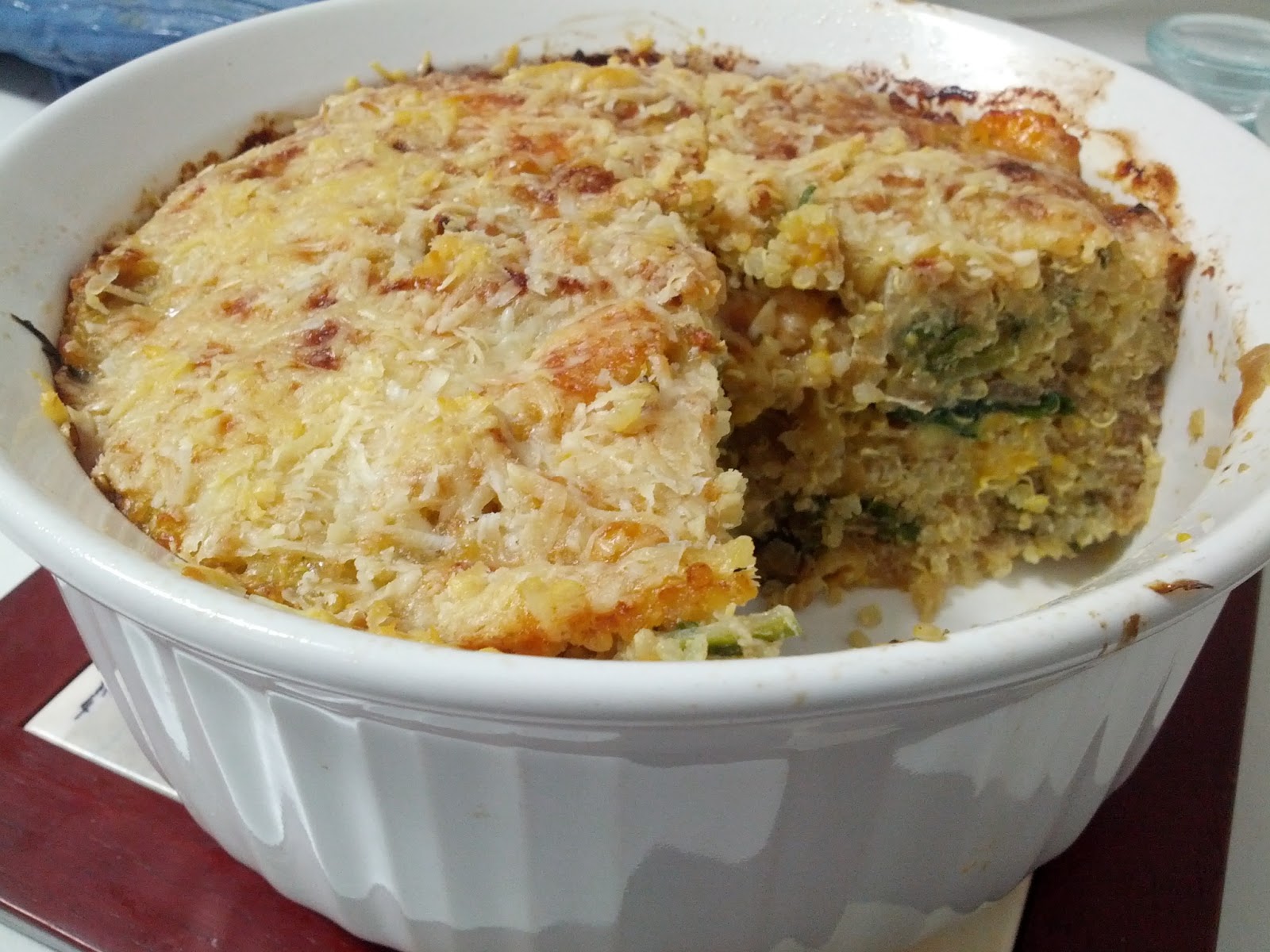
Cheesy quinoa pashtida


Would you believe me if I said quinoa is our new favorite food?

I remember tasting quinoa a long time ago and not liking it.  That's what happens when you treat it like rice and serve it barely seasoned, as a side dish.  Boring, bland, and weird texture.

But then we started tasting quinoa with other savory ingredients mixed in, and seasoned.  We tried some vegetables with quinoa stuffing.  The trick to quinoa is to mix it together with lots of other delicious things, and that led us to adapt this dish from a recipe we saw somewhere.

We've made this about four times in the last six weeks, and each time it's a little different.  The quinoa always gets soaked in water, then strained, and then boiled in 2 times whatever volume of dry quinoa you started with.  We always add chicken soup mix to the boiling water, which does a great job covering up quinoa's natural bland taste.

Then, sautee vegetables of your choice - we used onions, garlic, zucchini and מנגולד - a type of chard - with salt, pepper, garlic, etc.  After the quinoa is cooked, mix it with the veggies, 1 egg per cup of dry quinoa, and cheese.  Pour into a baking dish, top with grated Parmesan cheese and bake till bubbly.

With all that soup mix, egg, and cheese, one might wonder if the quinoa is really contributing here.  Believe me, it is.  Maybe not so much taste wise, but it definitely gives the whole thing a unique and addictive texture.    It's easy to eat through an insane amount of this stuff without even realizing.  Pretty much every time we make it for dinner, we have to force ourselves to save enough for lunch the next day.

Try it.

Tuesday, December 25, 2012

Go-to pizza toppings

These are some pizzas I made over Sukot, using the same dough I always use.  The pizzas tasted great, as all pizza does, but I'm far from satisfied with my crust.  I have long since ceased baking pizzas directly on my small round stone; the only way to avoid the invariable burning mess (when part of the pizza dangles over the stone) is to make unacceptably tiny pizzas.  Instead, I form the crust on a thin aluminum sheet, and bake that on the stone.  It's a method that seems to be getting worse with time, and I've reached the point where the crusts barely browns at all underneath.  The culprit may be oven temperature, or aluminum's heat capacity, or even soft Israeli flour.  I'm sure a good baking steel would solve my problems, but I don't know where to get one here and probably couldn't afford it anyway...

But I digress.  Here are some tasty pizzas:


Mozzarella, tomato sauce and basil.  Classic.  I went with the little balls of מוצרלה בייבי, a slight upgrade from theגבינת עמק on all the rest of the pizzas.  You can taste the difference, but only just.  The basil was fresh from the gahhden.


Carmelized onions, גבינת עמק, thyme, a dash of balsamic vinegar.  No tomato sauce.


טבעול veggie burgers sliced thin, fried in olive oil until crispy and seasoned with hot paprika.  גבינת עמק, tomato sauce.  Use Morningstar burgers in the US.


Mushroom pie.  Can't beat it.

Root Vegetable Soup


Around here we play a little game with the produce in the fridge.  It's called What's Gonna Go Bad Next?  The object of the game is to spot vegetables that look the most vulnerable to extended fridge time, and then make dinner out of them.  What are we going to do with that half bag of spinach?  We should REALLY use those zucchinis soon.  Ooooh, the cucumbers went bad.  Again.  (What is it with cucumbers?)

Sometimes, though, the game gets tiring.  For those times, it's good to make dinners like this one.  See, all the ingredients in this soup - onions, carrots, potatoes, and squash - are all things that we can count on having around and not going belly-up all of a sudden (although the carrots eventually get rubbery, which is the weirdest thing ever).

Besides the vegetables listed above, the soup was seasoned with chicken soup mix, pepper, garlic, and some paprika.  We like chicken soup mix, but you could probably get away without it if you don't want to use it, especially if you throw in a more aromatic root like parsnip.

Oh, and this soup is really good with pita chips like the one pictured above.  Just split some pita, cut into wedges, spray with some oil and season with salt and pepper before broiling in the oven.  Don't let them burn.

Friday, December 21, 2012

Kimchi

From everything I'd ever read about kimchi, it sounded like the best thing I've never tried - pickled cabbage seasoned with salt, sugar, soy sauce, fish sauce, ginger, chili pepper, and unholy amounts of garlic.  Actually, when I put it like that it sounds like heartburn, but still delicious.

Alas, our local שופרסל does not sell kimchi.  But I kind of wanted to make it myself anyway.  To do so, I used a recipe from Modernist Cuisine.  (It's kind of pathetic, but after having owned the book for over a year and a half, this might be the first actual recipe I've tried from it.  It's still an amazing book, but I use it more for reading and inspiration).  The recipe:

Sugar 75g
Salt 22g
Napa cabbage 825g
Garlic 100g
Fish sauce 65g
Light soy sauce 62g
Chili powder 48g
Scallions 37g
Ginger 25g
Carrot 30g
Dried salted shrimp 7g

Like all recipes, though, I had to make some changes.  It called for napa cabbage, which I couldn't get.  שופרסל online was selling something called כרוב סיני, so I ordered that.  When it arrived, I realized it was bok choy.  After a little Googling, I decided that bok choy wouldn't make good kimchi, and opted to go with plain cabbage instead.

Dried shrimp had to go, of course, but I did have the fish sauce!  This is quite an achievement, as it's very hard to find kosher fish sauce.  מזרח-מערב on Agripas in Jerusalem has it, as may other branches of this store.  The stuff kind of reeks, and Rachel once ran out of the room gagging when I tried cooking with it.  This might explain why not many have bothered making it in kosher form...

The first step was to combine the salt with 30g of the sugar, and rub down the cabbage.  I messed up and mixed the salt with ALL the sugar and rubbed down the cabbage:


Then, you let the cabbage sit in the fridge for 12 hours, after which you drain it, and mix it up with the rest of the ingredients (including the rest of the sugar).  I sort of compensated by throwing in a random amount of sugar.

Then you prep all the other stuff.  Side note - 100g of garlic is A LOT OF GARLIC.  Several heads.  Lots of garlic pressing.

Here's what it looked like to rub this mess onto the cabbage:


And here's all the cabbage, rubbed up and packed into a jar:


Then, all that's left to do is let it ferment for 24 weeks.

Wait.

Did I read that correctly?  24 weeks?  Are they insane?

Ha ha!  Turns out, there's a typo in my Modernist Cuisine cookbooks and it says 24 weeks instead of 2-4 weeks.  Good one, MC!

After about 3 weeks, we started eating it by itself:


Or sometimes with noodles:


My conclusion: kimchi is good stuff.  The cabbage stays crunchy, like sauerkraut.  Also like sauerkraut, it has an acidic touch to it.  And, it goes without saying, the stuff is knock-your-socks-off spicy and pungent.  A real punch in the mouth.

Therein, however, lies a dilemma.  The kimchi has such a strong taste that we don't really eat it alone.  We've been told that kimchi goes best with meat, but a) it has fish sauce in it (and I assume that's a problem) and b) I stupidly cut all the vegetables with a dairy knife.  So we can't have it with meat, and we still have a bunch of it sitting in the fridge.

Anyway, I'm sure this is just the first stop on a lifelong voyage through the land of DIY kimchi.  But before making the next batch, I think I'll detour for a batch of sauerkraut...